
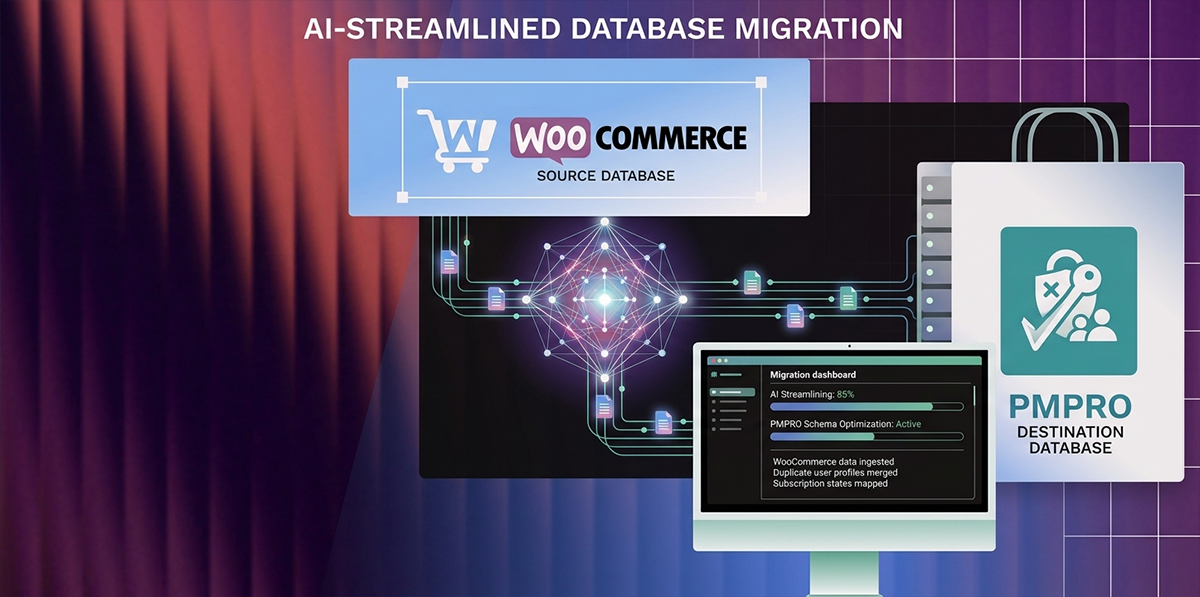
Recently, I had the opportunity to help one of my clients tackle a challenge that many organizations eventually face: their technology stack had outgrown its original purpose.
Their website had been using WooCommerce to manage memberships for years. At the time it was implemented, it made perfect sense. WooCommerce offered flexibility, payment processing, and a familiar interface. But as the organization evolved, it became clear that they no longer needed a full-featured e-commerce platform to support what had become a straightforward membership program.
The organization had also begun planning new members-only areas that would include protected documents, exclusive resources, and content available only to specific membership levels. This required more granular control over who could access what, and managing those permissions through an e-commerce platform was becoming increasingly cumbersome.
Instead, they needed a system built specifically for memberships.
After reviewing their requirements, we decided to migrate their membership program to Paid Memberships Pro (PMPro).
Looking Beyond Today’s Needs
The decision was not driven solely by performance improvements.
The client wanted to build a more robust member experience. They envisioned secure areas where members could log in and access documents, policies, templates, training materials, and other resources tailored to their membership level. They needed the ability to easily determine which members could view specific content and to adapt those permissions as their programs evolved.
PMPro offered the flexibility and control needed to make that possible.
By moving to a dedicated membership platform, the organization positioned itself not only to solve current challenges but also to support future growth.
The Problem with Traditional Migrations
Anyone who has worked on a database migration knows they can be stressful and time-consuming.
The conventional approach often involves exporting large datasets, transforming them into the correct format, importing them into the new system, and then troubleshooting any issues that arise along the way. Depending on the size of the membership base, this process can consume considerable server resources and require extensive testing.
For this client, I wanted to avoid unnecessary complexity.
Their existing WordPress user accounts were already in place. The goal was not to rebuild everything. It was simply to move the membership data into a platform better suited to both their current operations and their future plans.
A Different Approach
Rather than relying on exports and imports, I chose to migrate the data directly within the WordPress database.
Using custom PHP scripts, I identified each user’s existing WooCommerce membership information and transferred the relevant data into the appropriate PMPro tables. Because the migration occurred entirely within the existing environment, the process was both efficient and precise.
his approach offered several advantages:
- Existing user accounts remained untouched.
- Membership assignments stayed connected to the correct users.
- Large export files were not required.
- Server load was minimized.
- The migration completed significantly faster than traditional methods.
- Existing memberships were immediately ready to take advantage of the new protected content structure.
The entire process took a fraction of the time that a manual migration would have required.
Where AI Came In
One of the most interesting aspects of this project was the role artificial intelligence played behind the scenes.
Rather than starting with a blank editor and spending hours researching database structures and writing repetitive code from scratch, I used AI as a development assistant to accelerate the process.
AI helped generate the initial PHP scripts needed to perform the migration logic. It provided a solid starting point that could then be refined and adapted to the client’s specific environment.
Of course, this was not a case of blindly trusting generated code.
Every script still required professional oversight:
- Reviewing and validating the logic.
- Confirming how WooCommerce stored membership information.
- Mapping data accurately to PMPro’s structure.
- Testing in a controlled environment.
- Verifying the results before running the migration on the live site.
The expertise still came from understanding the systems involved and knowing what questions to ask. AI simply reduced the amount of time spent writing boilerplate code and accelerated the development process.
What could have been several days of work became a project completed in hours.
The Outcome
The benefits were immediately noticeable.
By removing the overhead of an e-commerce platform that was no longer aligned with the organization’s goals, the website became leaner and more responsive. Administrative workflows were simplified, and staff gained access to membership tools designed specifically for the way they operate.
Even more importantly, the organization now has the foundation it needs to expand its member offerings. New members-only sections can be created with confidence, protected documents can be shared securely, and access can be tailored to different membership levels without resorting to complicated workarounds.
The client now enjoys:
- Improved website performance.
- Reduced system complexity.
- Enhanced membership management capabilities.
- More precise control over member permissions.
- Secure access to client-protected documents and resources.
- The flexibility to expand members-only offerings over time.
- A platform designed specifically for memberships rather than online retail.
Perhaps most importantly, their members experienced little to no disruption. User accounts remained intact, memberships transferred successfully, and the transition happened quietly behind the scenes.
The Bigger Lesson
Projects like this highlight an important shift happening across the technology industry.
Artificial intelligence is not replacing experience and expertise. Instead, it is becoming a powerful tool that enables skilled professionals to work more efficiently. Used thoughtfully, AI can help accelerate development, reduce repetitive tasks, and free up time to focus on architecture, validation, and problem-solving.
For this client, combining purpose-built membership software with AI-assisted development resulted in a faster website, stronger access controls, and a future-ready member experience that will continue to evolve alongside the organization.
Sometimes the smartest solution is not adding more technology. It is choosing the right technology and using modern tools to implement it efficiently.
From the Blog:
How I Built a Resource Library and Membership System with JetEngine and Paid Memberships Pro

Managing AI Bots to Maintain Strong Website Performance and Optimal SEO
WordPress Developer vs. WordPress Editor: What’s the Difference?

The Importance of Having a Blog for Freelancers
Artificial Intelligence (AI) and Video Editing: Video Editors Matter, Now More Than Ever
Leave a Reply